

Best Automatic Feeder for Anxious Pets: 5 Top Picks
Table of Contents
- Why Anxious Pets Need a Different Kind of Feeder
- Quick Comparison: Best Automatic Feeders for Anxious Pets
- 1. Smart Pet Feeder With HD Camera: Best Automatic Pet Feeder With Camera
- 2. Automatic Pet Feeder WiFi Remote: Best Budget Option
- 3. Smart Pet Automatic Feeder With Remote Monitoring: Best for Multi-Pet Homes
- 4. Cat Food Automatic Timing Feeder Video Interactive: Best for Cats
- 5. Intelligent Feeding And Drinking All-in-one Machine: Best All-in-One
- How to Introduce an Automatic Feeder to a Nervous Cat
- Frequently Asked Questions
Last Updated: September 11, 2026
Why Anxious Pets Need a Different Kind of Feeder
The best automatic feeder for anxious pets is one that keeps meals predictable, quiet, and visible to you from anywhere. That combination matters more than capacity or app polish. According to Persistence Market Research's 2026 market forecast, the global automatic pet feeder market will grow from $543.8 million in 2026 to $981.4 million by 2033, an 8.8% annual growth rate driven largely by pet parents who travel and worry.
Here's the tension most buying guides skip: a feeder that dispenses food perfectly can still make an anxious pet worse. Research in the Journal of Animal Science, summarized by BC Group Medical, found that maintained feeding schedules reduce anxiety and support better digestion. The schedule is the medicine. The machine is just the delivery mechanism.
At Mac & Ellies pet shop, customers ask constantly: "I'm gone three days a week. Will this actually keep my dog on schedule?" Yes, if you pick a unit that fits your pet's specific anxiety triggers. A nervous cat who bolts at mechanical noise needs a different feeder than a senior dog who guards his bowl.
Below, we break down five feeders by anxiety profile, then walk through the desensitization protocol that makes the transition work.
The Three Anxiety Triggers a Feeder Has to Neutralize
Most reviews rank feeders by hopper size and app features. For an anxious pet, three hardware traits matter more:
1. Mechanical noise. Anxious cats and dogs startle at sudden, sharp sounds. A motor whirring at 60+ decibels is roughly as loud as normal conversation, enough to send a noise-sensitive cat under the bed. Quieter units run 40-50 dB, closer to a refrigerator hum. Look for a manufacturer-published decibel rating; if a brand doesn't publish one, the motor isn't a design priority. Test any unit in-store from three feet away.
2. Food-contact material. Anxious pets often have sensitive stomachs, and some owners worry about plastic leaching into kibble. Food-grade stainless steel bowls and BPA-free hoppers are safer. Look for explicit "BPA-free" or "food-grade" language, not "non-toxic," which is unregulated. Stainless steel is also easier to sanitize, since residual food oils can go rancid and put a picky eater off the feeder.
3. Routine precision. Anxiety responds to predictability, not features. A feeder that drifts late or skips a meal when Wi-Fi drops undermines the exact thing you bought it for. Prioritize battery backup and an on-device schedule that runs even when the app can't reach the cloud.
What Anxiety Actually Looks Like at Mealtime
Owners often miss the early signs because they look like normal behavior. Watch for:
- Pacing or vocalizing in the 30 minutes before a scheduled meal
- Eating in one or two fast gulps, then immediately leaving the bowl
- Refusing to eat if a person or another pet is in the room
- Hiding under furniture when the dispenser motor runs
- Over-grooming, lip-licking, or yawning right before mealtime
If two or more show up consistently, the feeder isn't a convenience purchase, it's a behavioral tool.
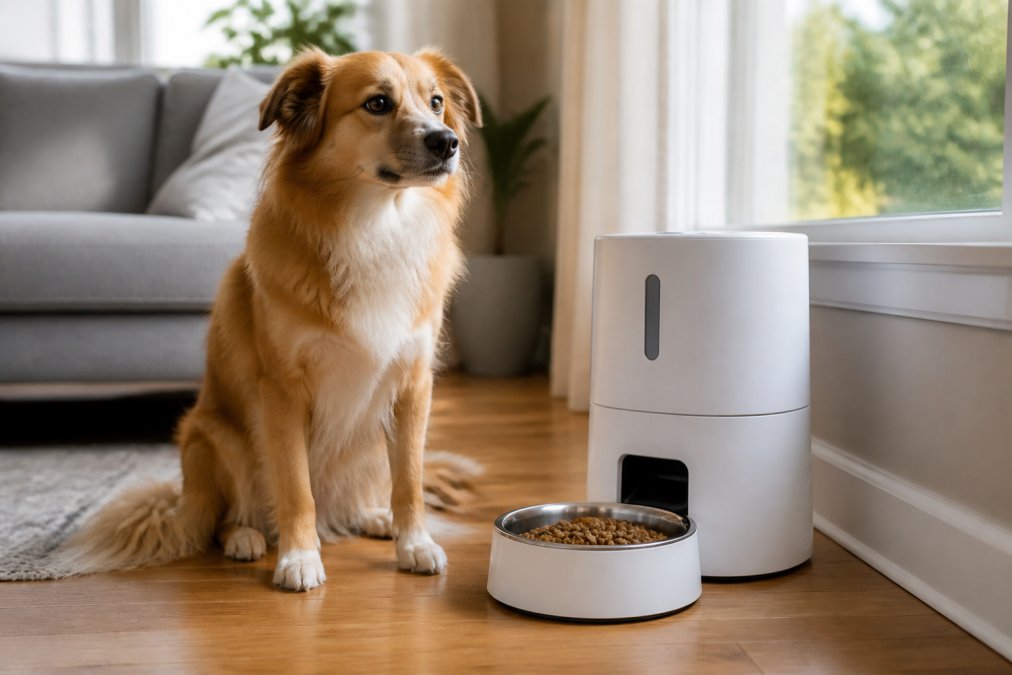
Quick Comparison: Best Automatic Feeders for Anxious Pets
| Feeder | Price | Best For | Anxiety Feature |
|---|---|---|---|
| Smart Pet Feeder With HD Camera | $154.99 | Remote reassurance | HD camera, app monitoring |
| Automatic Pet Feeder WiFi Remote | $102.99 | Budget buyers | WiFi remote dispensing |
| Smart Pet Automatic Feeder With Remote Monitoring | $658.99 | Multi-pet homes | Portion precision, notifications |
| Cat Food Automatic Timing Feeder Video Interactive | $309.99 | Cats | Interactive video |
| Intelligent Feeding And Drinking All-in-one | $479.99 | All-in-one setups | Food plus fresh water |
1. Smart Pet Feeder With HD Camera: Best Automatic Pet Feeder With Camera
If your pet's anxiety spikes when you're gone, seeing them eat is the whole point. Our top pick for remote reassurance: the built-in HD camera streams live video to your phone, so you can confirm your pet actually ate instead of guessing.
The programmable feeding schedule keeps meals consistent, the single most effective anxiety intervention. You can adjust portion sizes remotely and watch eating habits in real time, catching appetite changes early rather than after a three-day trip.
Key Specs and Pricing
- Price: $154.99, one-time purchase
- Camera: Built-in HD, smartphone streaming
- Feeding: Programmable schedule, remote dispensing
- Best for: Owners who travel and want visual confirmation
Pros and Cons
What works: The camera plus scheduling combo addresses both halves of separation anxiety, the routine and the uncertainty.
What doesn't: It's a single-bowl unit, so multi-pet households will need one per pet or a different approach.
2. Automatic Pet Feeder WiFi Remote: Best Budget Option
You don't need to spend $300 to solve separation anxiety. At $102.99, this WiFi-enabled feeder covers the essentials: remote dispensing through your phone, customized feeding times, and real-time monitoring of eating habits.
What most guides miss: consistency beats features for anxious pets. This one has a spacious hopper and works with most dry food types.
Key Specs and Pricing
- Price: $102.99, one-time purchase
- Connectivity: WiFi, smartphone app
- Feeding: Customized times, remote dispensing
- Best for: Budget-conscious owners who still want remote control
Pros and Cons
What works: Portion control and remote scheduling at the lowest price in this list. For a single pet on a fixed diet, nothing here is missing.
What doesn't: No camera. You get feeding confirmation through the app, not video. If watching your pet eat is what calms you down, step up to the camera model.
3. Smart Pet Automatic Feeder With Remote Monitoring: Best for Multi-Pet Homes
Food guarding is one of the most underrated sources of household pet anxiety. Research from the National Center for Biotechnology Information found that feeder systems providing individualized food access let owners separate pets at mealtime without isolating them in different rooms, which reduces stress for everyone involved.
This feeder targets exactly that problem. It dispenses precise portions at set times, tracks feeding history in the app, and sends notifications so you know each meal landed. The $658.99 price reflects precision engineering, not marketing.
Key Specs and Pricing
- Price: $658.99, one-time purchase
- Monitoring: Remote app, feeding history, notifications
- Feeding: Precise portion dispensing, adjustable remotely
- Best for: Multi-pet homes and food-guarding pets
Pros and Cons
What works: The feeding history log is genuinely useful. You can see whether your anxious pet ate at 7 a.m. or skipped, data a camera alone won't give you.
What doesn't: This is the most expensive option here. If you have one easygoing pet, you're paying for capability you won't use.
4. Cat Food Automatic Timing Feeder Video Interactive: Best for Cats
Cats with separation anxiety often need engagement, not just calories. This $309.99 feeder pairs scheduled meals with an interactive video feature that keeps your cat occupied while eating, reducing boredom-driven anxiety and the destructive behavior that follows.
Scheduled feedings with set portion sizes handle the routine side. The video interaction handles the connection side.
Key Specs and Pricing
- Price: $309.99, one-time purchase
- Feature: Interactive video
- Feeding: Set meal times and portion sizes
- Best for: Cats with boredom or separation-related anxiety
Pros and Cons
What works: The timing and portion controls match feline feeding needs.
What doesn't: Cats vary wildly in how they respond to screens. Some engage immediately; others ignore video entirely. If your cat falls in the second group, a camera-only model at a lower price does the same job.
5. Intelligent Feeding And Drinking All-in-one Machine: Best All-in-One
This $479.99 unit combines automatic food dispensing with fresh water delivery in one space-saving machine.
For owners managing both, this removes two daily tasks and two pieces of equipment from the floor. The consistent feeding schedule stays intact while your pet always has access to clean water.
Key Specs and Pricing
- Price: $479.99, one-time purchase
- Function: Automatic food dispensing plus fresh water
- Design: Single space-saving unit
- Best for: Owners who want one system for food and hydration
Pros and Cons
What works: Consolidation. One unit, one refill routine, one app. For small apartments especially, that matters.
What doesn't: If the water side fails, you lose the whole unit's usefulness until it's fixed. Owners who want redundancy should keep a separate water bowl as backup.
How to Introduce an Automatic Feeder to a Nervous Cat
Introducing an automatic feeder to a nervous cat takes 7 to 10 days of gradual desensitization. Skipping this step is the most common reason owners report their cat "hates" the feeder and refuses to eat from it.
Here's the protocol we recommend:
- Days 1-2: Place the feeder in its final spot, unplugged and empty. Let your cat investigate at will. Feed meals from the normal bowl nearby.
- Days 3-4: Plug the feeder in but don't dispense. Let your cat hear it idle. Feed normal meals in the same room.
- Days 5-6: Dispense one small portion while your cat watches, then immediately add their regular food to the same bowl. Pair the sound with something good.
- Days 7-8: Run one full meal through the feeder. Stay in the room. Don't hover or comfort excessively, which signals that something is wrong.
- Days 9-10: Run all meals through the feeder. Move to normal supervision levels.
- Day 11 onward: Resume your normal routine. If you're traveling, start with a short trip before a long one.
Desensitization Protocol
The core principle is pairing the feeder's sound and motion with food, never with a stressful event. A cat who hears the dispenser and gets fed learns the sound predicts something good; a cat who hears it and gets startled learns to fear it, an association much harder to undo than to prevent.
This is the same mechanism behind counter-conditioning, the standard behavioral approach for noise phobias: the feeder motor becomes a conditioned stimulus, a neutral sound that, through repeated pairing with food, predicts a positive outcome. The mistake most owners make is rushing the pairing: plugging the unit in and running a full meal on day one, so the cat's first association with the motor is a loud surprise with no food present yet. That builds fear, not a routine.
Two notes from practice. First, run the feeder's test-dispense function several times while your cat is in another room during days 3-4, so the mechanical noise becomes background rather than an event. Second, if your cat is highly noise-sensitive, prioritize quieter dispensing mechanisms and place the feeder on a non-resonant surface like a rubber mat rather than bare hardwood.
Adapting the Protocol for Dogs
The same 7-to-10-day structure works for dogs, with three adjustments:
- Shorten the early phases. Most dogs move through days 1-4 in half the time. If your dog is already approaching the feeder without hesitation by day 3, skip ahead.
- Use higher-value food during pairing. A piece of boiled chicken or a favorite treat dropped into the bowl right after the motor runs accelerates the positive association faster than kibble alone.
- Watch for food guarding, not just fear. A dog who stiffens, freezes, or stands over the bowl while it dispenses is showing resource-guarding behavior, not anxiety. That's a different problem, and the fix is usually feeding in a separate room rather than desensitizing to the machine.
When the Protocol Isn't Working
If your pet is still avoiding the feeder after two full weeks of consistent, gradual exposure, the issue is usually one of three things:
- The motor is too loud for that specific pet. Try a different unit or move the feeder to a carpeted room before assuming the pet can't adapt.
- The pairing was rushed. Go back to days 3-4 and slow down. There's no penalty for restarting the sequence.
- The anxiety is broader than mealtime. If your pet is also showing signs outside feeding, destructive behavior, house-soiling, excessive vocalization when you leave, a feeder won't fix it. That's a signal to involve your veterinarian, who may recommend a behavioral consult or a short course of anti-anxiety medication alongside the routine work.
Feeders manage routine; they don't treat clinical anxiety. If your pet's anxiety doesn't improve after two weeks on a consistent automated schedule, involve your veterinarian.
Frequently Asked Questions
Do vets recommend automatic feeders for anxious pets?
Veterinarians often suggest automatic feeders as part of a routine-based approach to managing pet anxiety. Consistent feeding schedules reduce stress and support better digestion, according to a 2026 Journal of Animal Science study. However, experts caution that feeders work best alongside other calming strategies like environmental enrichment and gradual desensitization, not as a standalone fix. Always consult your vet before making major changes to your pet's feeding routine.
How do I introduce an automatic feeder to a nervous cat without scaring her?
Start by placing the feeder in the room without turning it on, letting your cat sniff and explore it for a few days. Then run it empty on its quietest setting during mealtimes so she associates the sound with food. Gradually add food and use the manual dispense button while she watches. A 2026 study confirms that consistent schedules reduce anxiety, so keep the timing identical each day. Patience matters more than speed.
Are quiet automatic feeders better for nervous pets?
Yes. Mechanical noise is one of the top reasons anxious pets refuse to approach a feeder. A feeder with a quiet dispensing mechanism is often recommended for anxious animals because it works without startling them. When comparing options, look for models that dispense food without loud grinding or clicking. Lower decibel output means less stress during mealtimes and a smoother adjustment period for skittish pets.
Can an automatic pet feeder with camera actually help with separation anxiety?
A camera-equipped feeder lets you check in on your pet and speak to them through two-way audio while you are away. While a camera does not cure separation anxiety on its own, it supports a consistent routine and gives you real-time visibility into how your pet is eating. Pair it with scheduled feedings for the best results.
What features should I look for in a feeder for a skittish pet?
Prioritize four things: a quiet dispensing mechanism, dual power supply with battery backup so meals never stop during an outage, portion control for consistent servings, and a stainless steel bowl that is easy to clean and does not hold odors. If your pet is food-sensitive or you have multiple pets, microchip recognition prevents food theft. Remote monitoring and feeding history in a mobile app add peace of mind when you travel.
