

Rear Leg Brace for Large Dogs: 2026 Buyer's Guide
Table of Contents
- When a Rear Leg Brace for Large Dogs Beats Surgery (and When It Doesn't)
- How to Measure a Dog for a Leg Brace
- Dog CCL Tear Recovery: What Bracing Actually Does
- Dog Mobility Aids for Senior Pets: Braces, Harnesses, and Slings
- Custom vs Off-the-Shelf Rear Leg Braces: Fit, Materials, and Cost
- Muscle Atrophy and Gait Correction: What Most Guides Skip
- Frequently Asked Questions
Last Updated: September 13, 2026
When a Rear Leg Brace for Large Dogs Beats Surgery (and When It Doesn't)
A rear leg brace for large dogs is an external orthopedic device that stabilizes the stifle or tarsal joint, and for many owners it comes down to a single question: brace or operate? The dog knee brace market hit $312.4 million in 2025 and is projected to grow at 7.5% annually through 2034, per Dataintelo's dog knee brace market research, which tells you how many owners are now weighing that choice.
Clinical data favors surgery on satisfaction. A Colorado State Veterinary School comparative study found 98% owner satisfaction after surgery versus 85% with bracing. That gap matters, but it isn't the whole story.
Bracing wins when surgery isn't safe or affordable. Anesthesia risk in a 12-year-old dog, a $3,000+ surgical bill, or a partial tear rather than a full rupture all shift the calculus. A properly fitted brace also delivered a 35% improvement in joint stability and mobility for dogs with cranial cruciate ligament injuries, according to the Journal of Veterinary Science study on CCL bracing.
So where's the line? Bracing is the better first move for partial tears, arthritis-related instability, and dogs who can't tolerate surgery. Surgery remains the stronger long-term option for full ruptures in otherwise healthy dogs.
How to Measure a Dog for a Leg Brace
Accurate measurement is the difference between a brace that supports and one that rubs. You need three numbers: stifle circumference, hock circumference, and the distance between them, taken while the dog stands.
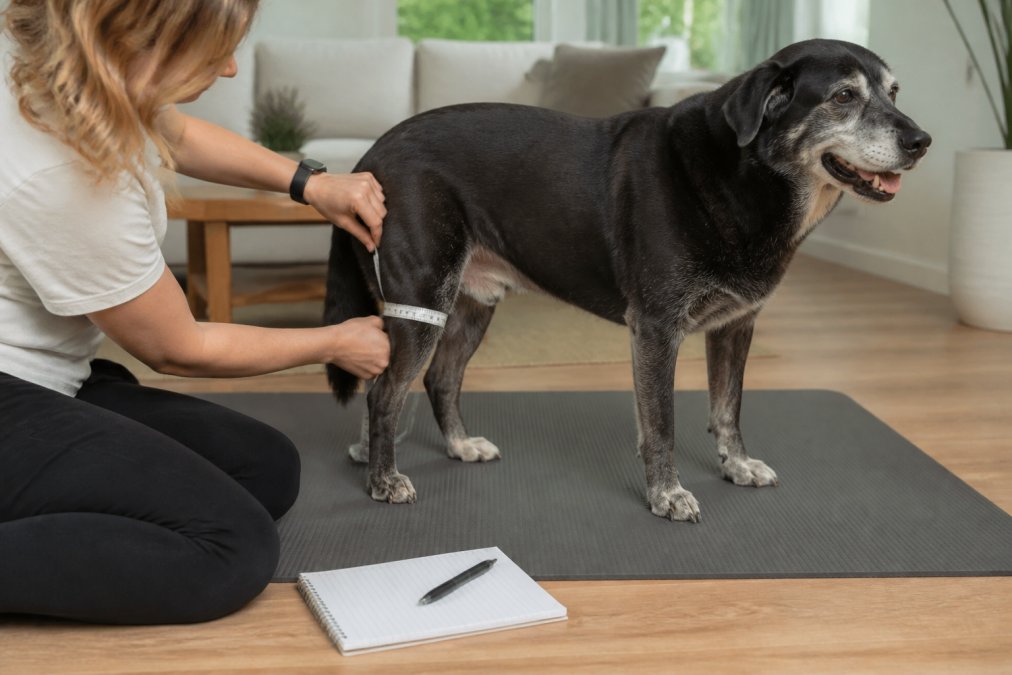
Here's the sequence most guides rush past:
- Have the dog stand squarely on a non-slip surface, not lie down
- Measure the widest point of the stifle joint (the knee)
- Measure the narrowest point above the hock
- Record the vertical distance between both points
- Repeat each measurement twice and average them
- Measure in centimeters, then convert using the maker's sizing chart
A common mistake is measuring a lying dog. Gravity shifts soft tissue, and the brace arrives too loose. For large breeds, a brace sizing chart from the manufacturer is not optional; it's the specification that decides whether the device works at all.
Dog CCL Tear Recovery: What Bracing Actually Does
A brace doesn't heal a torn ligament. It limits abnormal joint motion so scar tissue can form and the surrounding muscles can compensate. That's the one-sentence version every product page gives you. Here's the version that actually changes outcomes.
The mechanism, in plain terms
The cranial cruciate ligament (CCL) is the dog equivalent of the human ACL. When it tears, the tibia slides forward relative to the femur, veterinarians call this tibial thrust. A rear leg brace for large dogs works by resisting that forward slide and blocking hyperextension, the two motions that grind the joint during the inflammatory phase. It does not reattach the ligament, and it does not eliminate the instability. It buys the joint time to build a fibrous scar that partially stabilizes the stifle.
That distinction is why bracing outcomes vary so widely. A brace on a partial tear in a 9-year-old Labrador behaves very differently from a brace on a full rupture in a 3-year-old working shepherd.
A realistic recovery timeline
Most owners underestimate this by months. A common pattern practitioners describe:
- Weeks 1-2: Strict rest, brace worn for standing and short leash walks only. Ice and passive range-of-motion (ROM) exercises 2-3 times daily. Swelling peaks and begins to drop.
- Weeks 3-6: Controlled leash walks of 5-10 minutes, 2-3 times daily. Brace worn for all weight-bearing activity. Introduce weight-shifting exercises and controlled standing.
- Weeks 6-12: Gradual walk duration increase. Begin underwater treadmill or physiotherapy if available. Re-check brace fit, post-surgical or post-injury swelling drops significantly in this window.
- Months 3-6: Progressive strengthening. Short, supervised off-leash activity in a fenced area. Continue brace for high-impact or unpredictable terrain.
- Months 6-8: Return to normal activity for many dogs. Some owners keep the brace for stairs, car transfers, and slick floors indefinitely.
Eight months is a realistic full-return timeline, not a worst case. A case study from My Pet's Brace on a Labrador's recovery documented this with a 12-year-old Labrador Retriever.
When bracing fails
Bracing is not a universal substitute for surgery. It tends to fall short when:
- The tear is complete and the dog is young, active, and a good surgical candidate
- The dog is overweight, excess load overwhelms what a brace can offload
- The brace fit is wrong, which is the single most common reason owners report "it didn't work"
- The rehab protocol is skipped, so muscle compensation never develops
The rehab protocol is not optional
A brace supports. It does not condition. The exercises that actually rebuild stability, controlled standing, weight shifting, sit-to-stand repetitions, slow leash walking on varied surfaces, are what convert a supported joint into a functional one. Skipping them is the fastest route to a re-injury.
What to ask your veterinarian before you commit
Bring three questions to the appointment: Is the tear partial or complete? Is my dog a surgical candidate? And what does the rehab protocol look like week by week? The answers determine whether a brace is a bridge, a long-term tool, or the wrong call entirely.
Dog Mobility Aids for Senior Pets: Braces, Harnesses, and Slings
Braces are one tool in a larger kit. Senior dogs with hind limb weakness often need support at different points in the day, and matching the aid to the task makes more difference than buying the most expensive option.
| Mobility Aid | Best For | Key Limitation |
|---|---|---|
| Rear leg brace | Stifle instability, CCL tears, arthritis | Needs precise fit; not for full immobilization |
| Support harness | Stairs, car transfers, short walks | Doesn't stabilize the joint itself |
| Belly sling | Post-operative recovery, toileting support | Temporary use only |
| Toe grips | Slipping on hard floors | Minimal joint support |
For senior pets, combining aids works better than relying on one. A brace handles joint stability while a harness manages weight distribution during assisted movement. This is where most product pages stop, and it's the gap that leaves owners frustrated.
Custom vs Off-the-Shelf Rear Leg Braces: Fit, Materials, and Cost
For large breeds, custom-fit beats off-the-shelf almost every time, but "almost" is doing real work in that sentence, and most guides skip the nuance. Here's the honest breakdown.
What actually differs
| Factor | Off-the-Shelf | Custom-Molded |
|---|---|---|
| Fit precision | Sized by circumference ranges | Built to your dog's measurements or cast |
| Turnaround | Ships in days | Often 1-3 weeks |
| Adjustability | Relies on straps | Straps plus shell geometry |
| Cost | Lower entry point | Higher, varies widely by maker |
| Best for | Partial tears, arthritis, short-term support | Full ruptures, long-term wear, hard-to-fit anatomy |
| Resale / reuse | Can be re-fitted to another dog | Single-dog device |
Large breeds are the hardest to fit off-the-shelf because stifle and hock circumferences vary enormously across the same weight class. A 90-pound Greyhound and a 90-pound Rottweiler do not share a leg shape. The Posh Dog Knee Brace 2026 guide notes that large dogs have anatomical needs generic braces routinely miss, which leads to improper fit and reduced effectiveness.
Materials and comfort features that matter
Materials matter as much as measurements. Breathable neoprene keeps skin dry under extended wear, while adjustable straps accommodate swelling changes during recovery. Anti-slip designs and secure back straps are now considered baseline for high-energy large breeds. Two features worth prioritizing:
- Moisture-wicking liner: Extended wear under a brace traps heat and moisture, which is the leading cause of skin irritation on large dogs.
- At least one strap of adjustment room: Post-surgical swelling drops significantly in the first two weeks, and a brace sized to the swollen leg will be too loose by week three.
What it costs
Professional canine rear leg braces start around $134.99, based on Balto USA market pricing. Custom-molded options run higher, and pricing depends on the maker's sizing requirements and materials. Check with the manufacturer directly for current quotes rather than assuming a fixed range. Factor in the cost of a re-fit or replacement if your dog's leg shape changes with muscle loss or weight change during recovery, this is common and rarely mentioned on product pages.
The decision rule
If your dog has a partial tear, arthritis-related instability, or you need support fast, an off-the-shelf brace with a generous adjustment range is a reasonable first move. If your dog has a full rupture, is a long-term brace wearer, or has failed an off-the-shelf fit, go custom. The wrong fit is worse than no brace, it rubs, slips, and gives owners false confidence that bracing doesn't work.
Fitting check: how to spot slippage
A brace that slips is a brace that isn't working. Check three things after every walk:
- Strap marks: Even indentations are normal. Redness, hair loss, or broken skin means the brace is too tight or positioned wrong.
- Rotation: The brace should not rotate around the leg during normal walking. If it does, the shell geometry is wrong for your dog's anatomy.
- Gait: Watch your dog from behind. A properly fitted brace restores a near-normal stride. If the gait looks worse in the brace, the fit is wrong, not the dog.
Muscle Atrophy and Gait Correction: What Most Guides Skip
Every brace has a hidden cost: disuse atrophy. When a limb is supported externally, the muscles that normally stabilize the joint work less, and they shrink. This is the risk almost no product page mentions.
The fix is intentional loading. Short, controlled walks without the brace (once cleared by your vet) maintain muscle activation. Canine physiotherapy sessions focused on weight shifting and controlled standing build the stabilizers back up.
Gait correction is the other overlooked piece. A dog compensating for a bad leg develops an altered stride that stresses the opposite limb. Biomechanical alignment matters here: a properly fitted brace should restore a near-normal stride, not just hold the leg still. If your dog's gait looks worse in the brace, the fit is wrong.
Managing a large dog's rear leg injury is a long game, and the equipment is only half of it. Mac & Ellies pet shop carries practical tools that make daily routines easier, including video-interactive automatic feeders and hanging cage bowls. Our automatic feeders allow for remote check-ins and feeding, which can be helpful when coordinating pet care around a demanding job. Get started with Mac & Ellies pet shop for solutions designed to enhance pet ownership.
Frequently Asked Questions
Do vets recommend leg braces for dogs?
Yes, for specific cases. Veterinary guidance in 2026 says custom-fit braces are the most effective non-surgical option for torn CCLs and luxating patellas, especially in large breeds. A 2020 Journal of Veterinary Science study found dogs using properly fitted braces for CCL injuries saw a 35% improvement in joint stability and mobility. A Colorado State Veterinary School study published in 2026 reported 85% owner satisfaction with bracing versus 98% with surgery. Ask your vet whether your dog's condition suits a rear leg brace or needs surgical repair.
How do I know if my large dog needs a rear leg brace?
Watch for hind limb weakness, reluctance to climb stairs, stiffness after rest, or a sudden yelp followed by limping. These signs point to a ligament tear, canine arthritis, or medial patellar luxation. A vet exam confirms the diagnosis. If your dog has a CCL tear, hip dysplasia, or is recovering post-operatively, a rear leg brace for large dogs can provide weight-bearing support and reduce joint compression during daily movement.
How long should a dog wear a rear leg brace each day?
Start with short sessions of 20 to 30 minutes and build up over one to two weeks. Most dogs wear the brace during walks, potty breaks, and active periods, then remove it for rest. A My Pet's Brace case study followed a 12-year-old Labrador with a torn CCL who returned to normal activity after 8 months of consistent use. Your vet or a canine physiotherapy provider should set a daily wear schedule based on your dog's condition and rehabilitation protocol.
What is the difference between a custom and off-the-shelf dog leg brace?
Custom-molded braces are built from a 3D scan or cast of your dog's leg, so they match the stifle joint and biomechanical alignment precisely. Off-the-shelf options cost less but often slip on large breeds, causing therapeutic compression to land in the wrong spot. Industry guidance for 2026 notes custom-fit braces provide superior hind leg stability and comfort compared to non-custom alternatives. If your dog is over 50 pounds, a custom fit is usually worth the extra cost.
