


Best Automatic Feeders for Cats: 2026
Table of Contents
- Quick Comparison Table
- How We Tested Automatic Feeders
- Key Features to Look For in Automatic Feeders for Cats
- Best Automatic Cat Feeder for Wet Food
- How to Set Up an Automatic Cat Feeder
- Best Automatic Feeder for Multiple Cats
- Common Mistakes to Avoid
- Conclusion
- Frequently Asked Questions
Last Updated: September 3, 2026
Quick Comparison Table
| Feeder | Type | Best For | Key Strength |
|---|---|---|---|
| Mac & Ellies Smart Feeder | Smart/Wet Food | Remote monitoring | Video interaction + portion control |
| Petlibro Granary | Dry Food + Camera | Video monitoring | HD camera with app scheduling |
| SureFeed Microchip | Selective Access | Multi-pet homes | RFID security prevents food theft |
| Petlibro Polar | Wet Food | Wet food diets | Cooling system keeps food fresh |
| Petlibro Air | Dry Food | Budget-conscious | Quiet operation at low cost |
| Cat Mate C500 | Tray-based | Non-electronic preference | Proven reliability, dual food types |
| homerunPET PF20 | Dry Food | Capacity + freshness | Anti-jam sensor, 4L storage |
| Andoll Home | Dry Food | Dependable performance | Voice recording, dual power |
How We Tested Automatic Feeders
We tested each feeder for reliability, ease of use, build quality, and performance in real-world feline feeding scenarios.
We measured portion accuracy across multiple cycles, tested battery backup during simulated outages, and evaluated app responsiveness, Wi-Fi stability, and camera performance in low-light conditions.
We assessed mechanical durability, anti-jam mechanisms, corrosion resistance of stainless steel bowls, and seal integrity on wet food models.
We timed installation and evaluated app interfaces for intuitiveness and troubleshooting ease.
We assessed cleaning accessibility, dishwasher compatibility, and maintenance speed.
Key Features to Look For in Automatic Feeders for Cats
Several core features separate reliable feeders from unreliable ones.
Portion Control and Meal Scheduling
The best feeders allow exact portion sizes (down to 1/8 cup) and multiple daily meals with different portions (aafco.org). Consistent feeding times reduce stress and begging behavior while preventing obesity.
Anti-Jam Mechanisms
Anti-jam sensors detect when kibble bridges block the chute and either vibrate to dislodge food or alert you via app, preventing missed meals.
Power Reliability
Dual power supply (AC plus battery backup lasting 2-7 days) ensures feeding during outages (the FDA). Meal history storage confirms dispensing even after power loss.
Stainless Steel Bowls and Food Freshness
Stainless steel resists bacterial growth and corrosion. Sealed bowls with cooling systems keep wet food fresh; desiccant compartments extend dry food freshness.
App Connectivity and Remote Control
Smart feeders with Wi-Fi enable remote dispensing and eating pattern monitoring, but the best models include manual backup buttons for when internet drops.
Video and Audio Features
Cameras confirm meal dispensing; two-way audio and voice recording help anxious cats recognize feeding time.
Best Automatic Cat Feeder for Wet Food
Wet food requires sealed containers and cooling to prevent spoilage. The Petlibro Polar uses an integrated ice pack cooling system to keep food fresh.
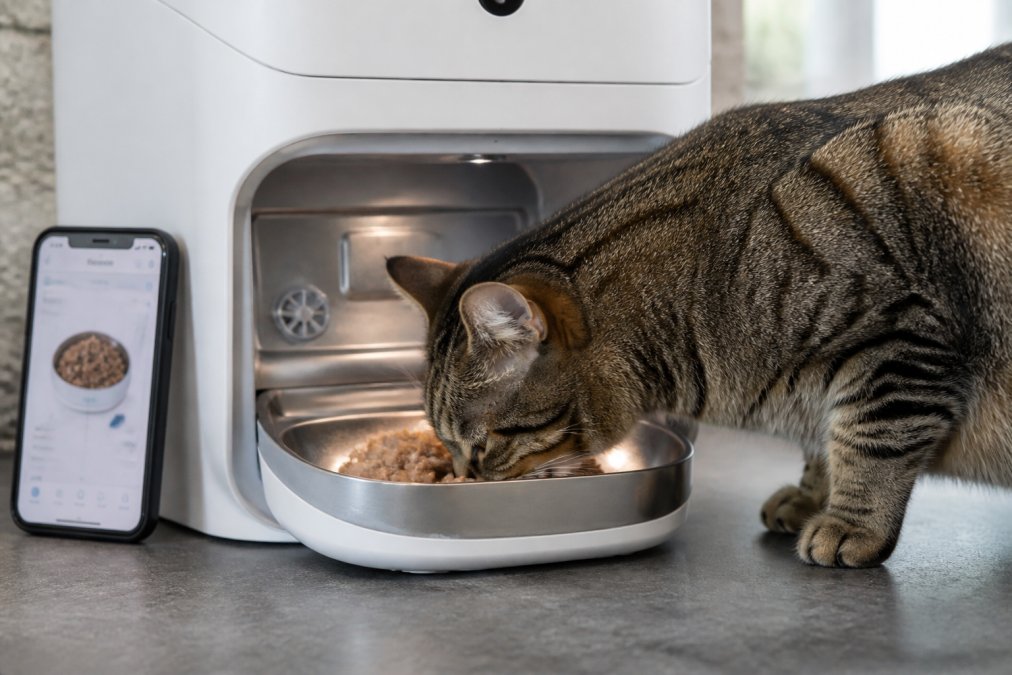
The Polar's removable ice pack maintains cool temperatures without freezing. The dishwasher-safe stainless steel bowl schedules up to 5 meals daily.
The Polar is the only mainstream automatic feeder for wet food diets, solving the challenge for cats requiring prescription food due to kidney disease, urinary issues, or digestive sensitivities.
The ice pack requires replacement every 8-10 hours (more frequently in summer heat), and small-portion cats may see food dry out despite cooling (peer-reviewed research).
For cats on wet food diets while owners work full days, the Petlibro Polar is the practical choice. It's more reliable than leaving wet food in a regular bowl for hours, and it maintains consistent meal timing that helps with digestive health.
How to Set Up an Automatic Cat Feeder
Most automatic feeders follow a similar setup sequence.
Step 1: Unbox and Inspect (5 minutes)
Check for shipping damage and verify all components (bowl, hopper, power adapter, batteries, app codes) are present.
Step 2: Assemble the Feeder (10-15 minutes)
Attach the bowl, insert the hopper, and secure the lid following the manufacturer's diagram to avoid jams or misalignment.
Step 3: Download the App (if applicable)
For smart feeders, download the brand's app before plugging in the device. Create your account and connect to your home Wi-Fi network. The app should prompt you to add the feeder by scanning a QR code on the device itself.
Step 4: Connect Power
Plug the feeder into an outlet near your cat's feeding area. The display should light up or the app should show the feeder as online. If using battery backup, insert fresh batteries now so they're ready if power fails.
Step 5: Program Your First Meal (10 minutes)
Set portion size via app or buttons, then test by dispensing in 5 minutes to confirm accuracy and adjust if needed.
Step 6: Schedule Recurring Meals
Input meal times and portions; most apps allow different portions for different times of day.
Step 7: Test Remote Features
For smart feeders, test the app's ability to dispense a meal remotely. Confirm the camera (if included) connects and video streams clearly. Test two-way audio by speaking through the app and listening for sound from the feeder's speaker.
Step 8: Establish Routine
Run the feeder for 3-5 days while monitoring eating patterns and portion accuracy; cats need adjustment time from manual feeding.
Best Automatic Feeder for Multiple Cats
Multi-cat households face challenges with different dietary needs and food theft. The SureFeed Microchip Pet Feeder uses RFID to recognize each cat's microchip.
The feeder reads your cat's existing microchip and opens only for the correct cat, preventing food theft and ensuring each cat eats their designated meal.
The sealed stainless steel bowl works with wet or dry food. The microchip system requires only a 9V battery lasting months, offering reliability without app or Wi-Fi dependence.
It excels for multi-cat households with different dietary needs or food-guarding behavior.
It requires one feeder per cat, the sealed lid opens slowly for some cats, and there's no remote monitoring or video.
For households with cats on different diets or with food-guarding behavior, the SureFeed approach is unmatched. You'll need one feeder per cat, but the security and simplicity justify the investment.
Common Mistakes to Avoid
Automatic feeders fail most often due to user error, not mechanical failure.
Mistake 1: Ignoring Portion Accuracy
Many owners don't confirm actual dispensed amounts, leading to overfeeding over time. Fix: Weigh portions with a kitchen scale monthly to ensure accuracy.
Mistake 2: Neglecting Hopper Cleanliness
Kibble dust accumulates and causes jams or mold. Fix: Empty and rinse the hopper weekly; wash wet food bowls immediately after meals.
Mistake 3: Overfilling the Hopper
A full hopper causes jams and inconsistent dispensing. Fix: Fill only three-quarters full and refill at the halfway mark.
Mistake 4: Ignoring Wi-Fi Stability
Weak Wi-Fi causes app lag, buffering, or dispensing failure. Fix: Test signal strength at the feeder location and move closer to router if needed; test remote dispensing weekly.
Mistake 5: Skipping Battery Backup Testing
Battery backup only works if tested. Fix: Monthly, unplug and test battery operation; replace batteries annually.
Mistake 6: Forgetting Behavioral Adjustment
Cats may not recognize feeder sounds as meal signals. Fix: Place kibbles in the bowl after dispensing during the first week; use voice recording features to signal mealtime.
Conclusion
The best automatic feeders simplify daily routines while maintaining precise portion control and food freshness. Mac & Ellies offers automatic pet feeders with video-interactive capabilities and app-based scheduling for your cat's dietary needs.
Choose a feeder matching your cat's behavior and lifestyle. Automatic feeders work best when set up correctly and monitored regularly, they enhance consistency but don't replace attention to eating patterns.
Frequently Asked Questions
What is the most reliable automatic cat feeder?
Reliability depends on your cat's diet and your needs. Microchip-based feeders like the SureFeed excel at preventing food theft in multi-pet homes, while camera-equipped models like the Petlibro Granary offer remote monitoring for anxious owners. Gravity-fed and tray-based systems like the Cat Mate C500 have fewer electronic components to fail, making them dependable for basic portion control. Battery backup and anti-jam mechanisms are critical reliability features.
Can I leave my cat alone for 4 days with an automatic feeder?
Yes, but only with proper setup. Automatic feeders with 4+ liter capacity and reliable portion control can dispense meals over multiple days. For wet food, cooling-equipped models keep meals fresh longer. Before extended trips, test your feeder's scheduling for 1-2 weeks to confirm accurate dispensing. Always provide backup water and consider a pet sitter for camera-equipped feeders so someone can monitor for jams or power issues.
How do I set up an automatic cat feeder for the first time?
Start by reading the manual completely. Fill the hopper with dry kibble or prepare wet food portions. Program meal times using the digital interface or app, starting with one meal per day. Test the dispenser without your cat present to confirm portion accuracy. Introduce your cat gradually, allowing them to investigate the feeder during manual feeding before automation begins. Check that the bowl is secure and the anti-jam sensor works properly.
Are automatic feeders worth it for cats?
Automatic feeders solve real problems: consistent meal schedules reduce begging, portion control helps prevent obesity, and remote monitoring eases separation anxiety for working owners. Multi-pet households benefit from microchip feeders that prevent food theft and manage prescription diets. However, they require regular cleaning, occasional troubleshooting, and aren't necessary for cats with free-fed dry food routines. The value depends on your schedule, your cat's dietary needs, and your peace of mind.
What should I do if my automatic feeder stops working?
First, check the power source and battery backup. Clear any kibble jams in the dispenser using the manual feed button. Ensure the bowl is properly seated and the lid seal is intact. For app-connected models, restart the device and check your Wi-Fi connection. Clean the hopper and dispensing mechanism thoroughly, as moisture or food debris often causes failures. If issues persist, contact the manufacturer's support team with details about the error.
Ready to simplify your cat's feeding routine? Explore Mac & Ellies pet shop's automatic pet feeders with video interaction features. Our feeders provide remote portion control, real-time monitoring, and the peace of mind that comes with knowing your cat is eating on schedule, whether you're at work or traveling. Pet feeding best practices recommend consistent meal timing for feline health, and automatic feeders deliver exactly that consistency.
This article was written using GrandRanker
