


Heavy Duty Training Collars for Dogs: 2026 Buyer's Guide
Table of Contents
- What Makes a Training Collar Heavy Duty?
- Top Picks: Heavy Duty Training Collars Compared
- Tactical Dog Collars with Handles: Built for Control
- How to Train a Dog with a Training Collar the Right Way
- Heavy Duty Dog Collar Safety Tips for Daily Use
- Which Heavy Duty Collar Should You Choose?
- Conclusion
- Frequently Asked Questions
Last Updated: September 6, 2026
The global market for electric dog collars is projected to hit $1,500.84 million by the end of 2026, up from $974.793 million in 2021 Cognitive Market Research Electric Dog Collars Market Report. That growth reflects a surge of interest in serious training tools, but it also means the market is flooded with cheap plastic options that snap under pressure. At Mac & Ellies pet shop, we offer gear designed for real-world wear, understanding the difference between a collar that lasts and one that fails during a critical recall.
Heavy duty training collars for dogs are defined by their materials, hardware, and construction, not just their price tag. This guide breaks down what separates durable gear from the rest, reviews top picks for 2026, and covers safe training methods.
What Makes a Training Collar Heavy Duty?
The Core Material: Nylon Webbing and Its Limits
The foundation of nearly all heavy duty collars is nylon webbing, but not all nylon is created equal. The key specification is the material's tensile strength, measured in psi or as a total breaking strength for a given width.
- Standard Flat Webbing: Typically 1-inch wide, this is common on everyday collars. It has a breaking strength of roughly 300-600 lbs. It is flexible but can stretch and fray under constant, high-force pulling.
- Heavy Duty Webbing: This is usually 1.5-inch or 2-inch wide, made from a tighter weave of higher-denier nylon (e.g., 1000D or 1680D ballistic nylon). This construction can yield a breaking strength of 1,500 to over 3,000 lbs, depending on the specific material and weave.
- Biothane: A synthetic alternative to leather, Biothane is a nylon core coated with a waterproof, smooth PVC. It is incredibly durable, does not absorb water or odors, and is easy to sanitize, making it a favorite for professional K9 units and waterfowl hunters. Its lack of give, however, means it can be less forgiving on the dog's neck during sudden jerks.
The Critical Failure Points: Hardware and Stitching
A collar is only as strong as its weakest link. While the webbing might be rated for 2,000 lbs, a cheap, stamped-metal D-ring will bend and snap at a fraction of that force. Here is what separates professional-grade hardware:
- D-Rings: Look for solid stainless steel rings, which are forged or machined from a single piece of metal. Avoid rolled steel or plated rings, which are often hollow or have a seam that can split. The D-ring should be welded closed, not just bent, to prevent it from opening under pressure.
- Buckles: Heavy duty buckles are typically made from cast metal (like zinc alloy) or reinforced plastic. The best plastic buckles, such as those from ITW Nexus, are glass-reinforced nylon and are rated to withstand extreme cold without becoming brittle. A metal buckle is more robust but can be cold to the touch in winter.
- Stitching: The most common point of failure is where the D-ring is attached. Look for bar-tacking, a dense, zigzag stitch pattern that reinforces stress points. The webbing should be looped back and stitched with a heavy-duty thread (like bonded nylon) in a box-and-X pattern. A collar that is only stitched along the edges will unravel quickly.
The 'Handle' Test: A Case Study in Construction
Tactical collars with handles are a prime example of how construction quality varies. On a poorly made collar, the handle is simply stitched onto the top of the webbing, so the force of a lunging dog concentrates on those few stitches and rips them out.
A properly constructed tactical collar integrates the handle into the collar's core, threading it through the main body before stitching, creating a continuous loop that distributes force across the entire width. When evaluating a collar, twist the handle; if you see the main webbing bunching inside the sleeve, it is likely a high-quality, integrated design.
The Role of Standards and Testing
While there is no single federal standard for dog collars, many top-tier manufacturers voluntarily test against military or industrial standards. For example, a manufacturer might state that their webbing meets or exceeds Mil-Spec MIL-W-4088, a common specification for high-strength nylon webbing. This is a more reliable indicator of durability than a vague claim of being "heavy duty."
The 6-Month Real-World Wear Test
Collars with powder-coated metal hardware can show wear at contact points where the leash clip rubs against the D-ring, potentially exposing bare metal to corrosion. In contrast, solid stainless steel hardware tends to show less visible signs of wear or rust. Similarly, the edges of standard nylon webbing can fray against abrasive surfaces, while tighter-weave ballistic nylon often remains intact. The initial cost of a higher-quality collar can be offset by its significantly longer lifespan.
Choosing the Right Width for Your Dog's Strength
The width of the collar must be matched to the dog's pulling force. A 1.5-inch collar is standard for most large breeds (70-100 lbs), distributing pressure over a wider area. For giant breeds (over 100 lbs) or powerful pullers, a 2-inch wide collar is recommended to prevent neck strain. A wider collar is critical for protecting the dog's trachea and cervical spine from concentrated pressure.
Top Picks: Heavy Duty Training Collars Compared
The best heavy duty training collars combine durable construction with practical training features. We’ve selected three options from Mac & Ellies that cover different training needs, from basic obedience to long-range recall and containment.
| Product | Price | Best For | Key Feature |
|---|---|---|---|
| Dog Training Collar | $96.99 | Obedience and recall work | Adjustable fit, durable daily construction |
| 800m Electric Dog Training Collar | $53.32 | Long-range training and water work | 800m range, IP67 waterproof, 0-99 levels |
| Wireless Electric Pet Dog Fence | $343.99 | Containment without physical barriers | 4 working modes, customizable intensity |
Dog Training Collar: The All-Rounder for Obedience Work
Our top pick for most owners is the Dog Training Collar at $96.99. It’s a professional-grade collar designed for clear communication during obedience training, recall work, and behavioral reinforcement. The adjustable fit grows with your dog, and the durable construction stands up to daily use.
The easy-to-grip design gives you confident handling during active sessions. A collar that slips or rotates during a correction undermines your training; this one stays put and maintains comfort and safety even during intense work.
800m Electric Dog Training Collar: Maximum Range and Waterproofing
The 800m Electric Dog Training Collar Anti-barking Device is our pick for owners who train in open spaces or near water. It delivers an 800-meter control range and an IP67 waterproof, dustproof receiver, so your dog can swim and even dive while wearing it.
This collar offers 99 independent static levels plus vibration and sound modes, giving you fine control over the correction intensity. Rechargeable lithium batteries keep the controller running for 6-8 weeks per charge and the receiver for 2-3 weeks INVIROX product feature specifications for rechargeable training collars. The adjustable collar fits necks from 7.87 to 28.3 inches, accommodating most large breeds.
Tactical Dog Collars with Handles: Built for Control
Tactical dog collars with handles give handlers immediate physical control without reaching for the leash. The built-in handle sits at the back of the neck, letting you steady a dog during vet visits, break up a fight, or guide a dog through a crowded space. This design is standard for working dogs and increasingly popular among owners of high-energy breeds.
The best tactical collars use heavy-duty webbing and a control handle stitched through the full width of the collar, not just tacked on at the edges. When you grab the handle, the force distributes across the collar’s structure rather than concentrating on a weak point.
Pair a tactical collar with a sturdy leash that has a heavy-duty clip. A standard lightweight leash clip can bend or break under the force a tactical collar is designed to handle. Look for a leash rated to match your dog’s pulling strength, and check both the collar’s D-ring and the leash’s clip before every training session.
How to Train a Dog with a Training Collar the Right Way
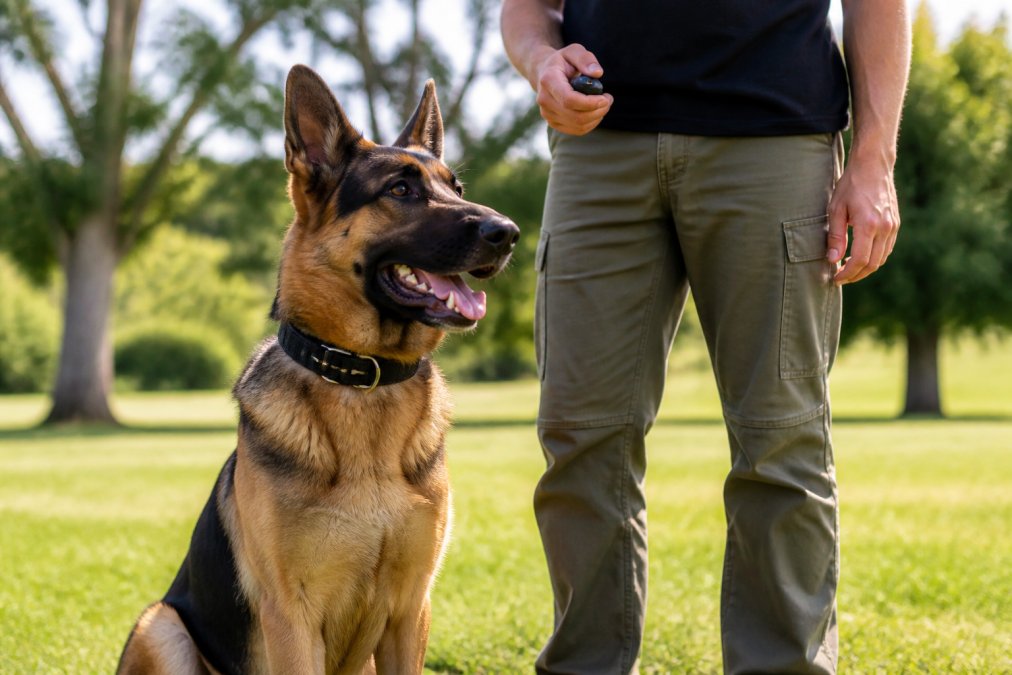
The most durable collar in the world is useless, and potentially harmful, if used incorrectly. Training with a heavy duty collar is not about applying more force; it is about precise communication. The goal is to build a reliable, positive association with the collar so your dog responds correctly even in high-distraction environments.
The Two Philosophies: Compulsion vs. Communication
Before you start, understand the fundamental difference in how a training collar can be used. The outdated, compulsion-based model views the collar as a tool to punish unwanted behavior. The modern, science-backed approach views it as a communication device that marks a moment in time, allowing you to reward the correct behavior.
- Compulsion Model: The dog pulls, you correct, the dog stops pulling to avoid the correction. This is reactive and can create anxiety.
- Communication Model: You use a cue (a sound, vibration, or a gentle leash pop) to get the dog's attention before it engages in an unwanted behavior. You then immediately reward the dog for disengaging and focusing on you. This is proactive and builds trust.
The 'Low and Slow' Protocol for Electronic Collars
If you are using an electronic collar, the most critical rule is to start with the lowest possible stimulation level and find your dog's 'working level.' This is not the level that makes the dog yelp; it is the level at which the dog's ears perk up or it looks at you with curiosity.
- Introduce the Collar: Let your dog wear the collar for a few days without turning it on. This desensitizes them to the feel of the receiver on their neck.
- Find the Working Level: With the collar on, start at level 1 and press the continuous button for 1 second. Watch for a subtle reaction, a flick of the ear, a pause in breathing, a glance your way. If you see nothing, move up one level. The working level is the first level that gets a noticeable but non-painful reaction.
- Pair the Stimulation with a Cue: Once you find the working level, pair it with a known command. For recall, say "Come" and immediately press the stimulation button. The moment your dog turns toward you, release the button and reward with a high-value treat.
- The 'Tap' Method: Use a very brief, 0.1-second tap of stimulation, not a long, sustained shock. The tap is a 'nudge' to get attention. A long stimulation is painful and confusing.
The Leash Mechanics of a 'Pop' Correction
For flat collars or martingale collars, the 'pop' correction is a core skill. It is not a hard yank; it is a quick, sharp snap of the leash that creates a brief tightening of the collar, followed by an immediate release.
- The Wrist Flick: The correction comes from your wrist, not your arm. Keep your elbow close to your body and use a quick flick of your wrist to create a 6-12 inch snap of the leash.
- Timing is Everything: The pop must occur the instant your dog's attention leaves you or it begins to pull. A delay of even half a second teaches the dog nothing.
- The Release is the Reward: The moment the leash goes slack, your dog is rewarded by the release of pressure. This is why the pop must be quick. If you hold the tension, you are teaching the dog to pull against a constant force.
The 'Premack Principle' for High-Drive Dogs
For high-energy breeds, the most powerful reward is not a treat, it is the opportunity to do the thing they want to do. This is the Premack Principle: a more probable behavior (like chasing a ball) can reinforce a less probable behavior (like a 'sit').
In practice, this means using the training collar to get a reliable 'sit' or 'down' before you throw the ball. The command becomes the price of admission for the fun activity. This is far more effective than punishing a dog for not coming when called, which creates a negative association with the recall command.
The 'Leash Pressure' Conversation
Many owners make the mistake of using a heavy duty collar with a static leash and expecting the dog to understand the pressure. You must teach your dog that pressure on the collar means "move toward me":
- Stand still with your dog on a loose leash.
- Apply gentle, steady pressure on the leash, perpendicular to your body.
- The moment your dog takes one step toward you to relieve the pressure, release the tension and reward.
- Repeat until your dog immediately turns and moves toward you when it feels any pressure on the collar.
This 'yield to pressure' exercise is the foundation of loose-leash walking and reliable recall. It teaches the dog that the collar is a signal, not a restraint.
A Note on Bungee Leashes and High-Energy Dogs
A bungee leash is designed to absorb the shock of a sudden lunge, which can be beneficial for a dog's neck and your shoulder. However, this shock absorption works against you when delivering a clear, sharp 'pop' correction. The bungee will absorb the energy of your wrist flick, turning a precise correction into a mushy, ineffective pull.
The Rule of Thumb: Use a static, non-elastic lead for training sessions where you need clear communication. Reserve the bungee leash for casual walks where the goal is comfort and shock absorption, not precise training.
Heavy Duty Dog Collar Safety Tips for Daily Use
Heavy duty dog collar safety tips begin with proper fit and end with regular inspection. A collar that’s too loose can slip off over your dog’s head, while one that’s too tight can cause neck injuries or skin irritation. You should be able to fit two fingers flat between the collar and your dog’s neck.
Daily use demands attention to several factors:
- Check for wear weekly: Look for frayed stitching, cracked buckles, or rust on hardware
- Remove the collar during crate time: A collar can catch on crate bars and cause injury
- Rotate the collar position: This prevents matting and skin irritation on one spot
- Clean it regularly: Dirt and moisture degrade webbing faster than normal use
Neck health deserves special attention with training collars. Repeated hard corrections on a thin collar concentrated pressure on the trachea and cervical spine. A wide, padded collar distributes that force across a larger area. If you’re using an electronic collar, the contact points should sit snugly against the skin but never dig in.
Which Heavy Duty Collar Should You Choose?
Your choice of heavy duty training collars comes down to your training goals and your dog’s specific needs. For most owners, the Dog Training Collar offers the best balance of durability, comfort, and everyday usability at $96.99. It handles obedience work, daily walks, and recall training without the complexity of electronic features.
If you train in open fields, near water, or need long-range control, the 800m Electric Dog Training Collar at $53.32 gives you the range and waterproofing to work in any conditions. Its 0-99 level system and IP67 rating make it a versatile tool for serious training.
For owners who need containment without building a physical fence, the Wireless Electric Pet Dog Fence at $343.99 provides four working modes and covers yards, camping trips, and travel. It’s the most expensive option, but it replaces a permanent fence installation and works anywhere you go.
Conclusion
Choosing the right heavy duty training collar for your dog is about matching the tool to the job, whether that’s daily obedience, long-range recall, or reliable containment. Every dog deserves gear that’s built to last, fits properly, and supports humane training methods.
At Mac & Ellies pet shop, we carry training collars, wireless fences, and feeding solutions designed for active, busy pet parents. Our collars feature adjustable fits, durable construction, and waterproof designs that stand up to real-world use. Get started with Mac & Ellies pet shop and find the right training gear for your dog today.
Frequently Asked Questions
What is the difference between a shock collar and a training collar?
A shock collar is a type of training collar, but not all training collars use static stimulation. Modern heavy duty training collars often offer multiple modes, including tone and vibration, which many owners try before using static stimulation. The goal is communication, not punishment. Think of the collar as a way to get your dog's attention at a distance so you can reinforce a command you have already taught.
What features should I look for in a heavy duty training collar for a large breed?
Focus on three areas: durability, fit, and power. Look for reinforced nylon webbing and stainless steel hardware that can handle daily pulling. The collar should be wide enough to distribute pressure, typically 1 to 1.5 inches, and have an adjustable fit for your dog's neck circumference. If you choose an electronic model, check the battery life and range to ensure it matches your training environment.
Are heavy duty training collars safe for everyday wear?
A heavy duty training collar is safe for training sessions, but it should not be worn 24/7. Prolonged wear can irritate the skin and create a pressure point on the neck. Remove the collar after each session and give your dog's neck a break. For daily identification, consider a separate, lighter flat collar. Always follow the manufacturer's guidelines for wear time and check the fit regularly as your dog adjusts.
How do I choose the right size training collar for my dog?
Measure your dog's neck with a flexible tape measure. Place it snugly where the collar will sit, usually the base of the neck, and add two fingers of space for comfort. Heavy duty collars often come in size ranges, so match your measurement to the product specifications. A collar that is too loose can slip off, while one that is too tight can cause injury or discomfort during training.
