

Durable Leashes for Large Dogs: 2026 Buyer's Guide
Table of Contents
- Quick Comparison: Durable Leashes for Large Dogs
- What Makes a Leash Durable Enough for a Large Dog?
- Best Leash Length for Large Dog Training
- How to Stop a Large Dog from Pulling on the Leash
- Heavy Duty Training Collars for Large Dogs: What to Look For
- Top Durable Leashes for Large Dogs at Mac & Ellies
- Maintenance Tips to Extend Leash Life
- Frequently Asked Questions
Last Updated: September 14, 2026
Quick Comparison: Durable Leashes for Large Dogs
The global dog leash market is projected to grow at a 7.00% compound annual growth rate through 2030, driven by demand for specialized equipment (Cognitive Market Research dog leash market report). At Mac & Ellies pet shop, we've watched that demand shift toward one clear priority: gear that survives a 90-pound dog hitting the end of the line at full speed. This guide breaks down what actually makes durable leashes for large dogs worth buying, from tensile strength to hardware failure points.
Leash construction matters more than brand marketing. A leash rated for 154 pounds can still fail at the clip if the metal is cheap. Below, we'll show you exactly how to evaluate materials, pick the right length, and stop pulling before it becomes a shoulder injury.
| Leash | Price | Material | Best For |
|---|---|---|---|
| Cowhide Dog Leash | $7.94 | Leather | Strong pullers, classic feel |
| Nylon Braided Rope Set | $6.98 | Climbing rope | Training, all-weather use |
| Dual-Headed Retractable | $21.14 | Nylon webbing | Two dogs, night walks |
| Layers of Yarn Leash | $12.74 | Nylon yarn | Smaller dogs, cats |
What Makes a Leash Durable Enough for a Large Dog?
Durability for a large dog comes down to two things: the tensile strength of the material and the quality of the hardware where the leash meets the collar. A leash is only as strong as its weakest point, and that point is almost always the clip.
Materials and Tensile Strength
Tensile strength is the maximum load a material can bear before it breaks. Heavy-duty nylon webbing and climbing rope consistently outperform flat woven straps because the braided structure distributes force across multiple threads.
BioThane is gaining traction for large dogs because it's waterproof and holds high tensile strength (Hightail Hikes on BioThane for large dogs). Leather remains a strong option too. Professional K9 training gear standards point to northern cowhide with a tight grain structure as the benchmark for the most durable leather leashes (Ray Allen K9 leash guide).
Hardware Durability: Swivel Clips and Snap Hooks
Here's what most guides miss: even heavy-duty brands can show premature wear at the collar clip. Material thickness alone doesn't guarantee longevity. A swivel clip that rotates 360 degrees prevents the twisting that fatigues metal over time. Look for corrosion-resistant finishes if you walk in wet conditions.
Best Leash Length for Large Dog Training
The best leash length for large dog training is 4 to 6 feet for everyday walks and obedience work. This range gives you enough slack for natural movement while keeping the dog close enough to correct pulling behavior immediately.
Longer lines have their place. A 15 to 30 foot training lead works for recall practice in open spaces, but it's a training tool, not a walking leash. Retractable leashes extend up to 26 feet, though trainers often prefer fixed-length options for better control and durability (TreeLine Review best dog leashes).
| Use Case | Recommended Length | Why |
|---|---|---|
| Everyday walks | 4-6 feet | Control plus natural movement |
| Obedience training | 4-6 feet | Quick corrections |
| Recall practice | 15-30 feet | Distance work in open areas |
| Two-dog walks | 10 feet per dog | Prevents tangling |
How to Stop a Large Dog from Pulling on the Leash
Stopping a large dog from pulling starts with removing the reward. A dog pulls because pulling gets it where it wants to go. The moment the leash goes tight, stop walking. Wait for slack, then move forward. That principle is universal, but how you apply it depends on what kind of large dog is on the other end of the leash.
Two Very Different Pullers
Most guides treat "large dog" as one category. It isn't. The mechanics of pulling split into two groups, and the leash and harness setup that works for one can be wrong for the other.
High-drive, athletic pullers (Huskies, German Shepherds, Boxers, Pit Bull-type breeds). These dogs pull from forward momentum and prey drive. They accelerate into the leash, so the load arrives as a sharp jolt. They need hardware that resists impact fatigue, a forged clip, a free-spinning swivel, and a leash with some elasticity or braided structure to absorb the shock. A front-clip harness redirects their forward drive sideways, which is the most effective single change for this group.
Heavy-set, low-center-of-gravity breeds (Mastiffs, Great Danes, Newfoundlands, Saint Bernards). These dogs pull from mass and inertia rather than speed. The load arrives as a slow, sustained drag that never releases. They need a wider collar or harness band to spread pressure across a larger neck and chest area, and a shorter leash length so you are never managing slack you can't control. A front-clip harness helps less here because there is no forward lunge to redirect, the dog simply leans, and the handler's leverage is the limiting factor.
Matching the Tool to the Dog
A front-clip harness redirects forward momentum sideways, which is far more effective than a neck-only setup for powerful dogs. The National Center for Biotechnology Information notes that no single walking device works best for every dog; selection must match the individual animal's behavior (NCBI review of collars, harnesses, and head collars).
- Front-clip harness: Best for athletic pullers with a forward lunge. Less effective for leaners.
- Head halter: Gives the most leverage per pound of handler effort, but requires slow conditioning and is a poor fit for flat-faced or thick-necked breeds.
- Martingale collar: Suits strong pullers with a neck-to-head ratio that lets a flat collar slip, but it does not stop pulling, it only prevents escape.
- Back-clip harness: Comfortable for the dog but actually encourages pulling in high-drive breeds because it gives them a brace point.
A traffic handle, the second loop near the clip, gives you instant close control in tight spots. Products with a secondary handle are trending for exactly this reason (Wirecutter leash reviews). For a heavy-set breed, the traffic handle is not a convenience, it is the primary control point, because it lets you shorten the effective leash length without re-gripping.
Leash Weight and Harness Balance
A detail almost no guide covers: leash weight affects harness balance on large dogs. A heavy leather or thick rope leash hanging from a back-clip harness pulls the harness off-center, especially on a narrow-chested dog, which shifts pressure onto the shoulders and can cause chafing on long walks. A lighter webbing or BioThane leash keeps the harness sitting square. If your dog wears a harness with a back attachment, match the leash weight to the harness, a heavy leash on a light harness is a fit problem, not just a comfort one.
The Stop-and-Go Pattern, Adjusted for Size
For an athletic puller, the stop is immediate and the reset is quick, a few seconds of slack, then forward. For a heavy-set dog, the stop needs to be longer, because the dog has to physically shift its weight back before slack appears. Rushing the reset teaches the leaner that leaning still works.
Pair your leash with a harness that fits properly, since leash-to-harness compatibility affects how well corrections transmit. A correction that reaches the dog as a vague tug teaches nothing; a correction that arrives as a clear, brief signal is what changes the behavior.
Heavy Duty Training Collars for Large Dogs: What to Look For
Heavy duty training collars for large dogs need reinforced stitching, a weight rating that exceeds your dog's actual weight, and hardware sized to the load. A martingale-style collar, which tightens slightly under tension but won't choke, suits strong pullers better than a flat buckle collar.
Breed matters here, and most guides skip it. A Labrador with a thick neck needs a wider collar band to spread pressure than a lean Husky of the same weight. Measure neck circumference, not just weight, before buying.
- Reinforced stitching at every stress point
- Weight rating at least 20% above your dog's weight
- Corrosion-resistant hardware for wet climates
- Quick-release buckles only if they're rated for the load
Top Durable Leashes for Large Dogs at Mac & Ellies
Every leash below is built for real-world load, and each one suits a different walking scenario. We carry these four because they cover the range from budget training gear to two-dog night walks.
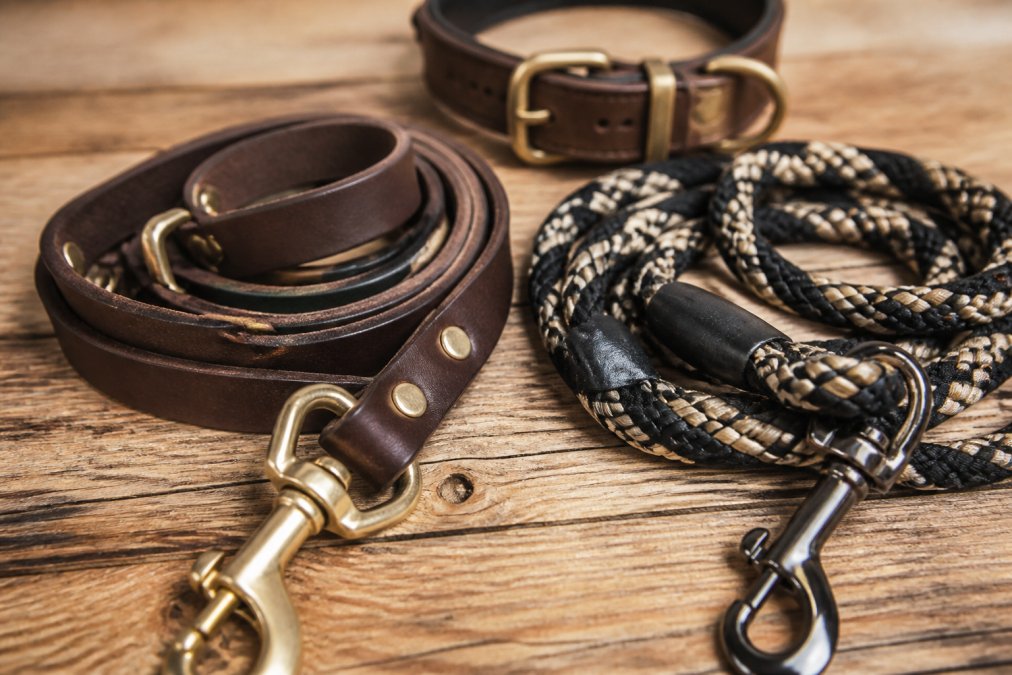
Cowhide Dog Leash: Classic Leather Strength
The Cowhide Dog Leash is our pick for strong pullers who walk in dry conditions. It comes in two widths: 1.6 cm for dogs from 30-50 kg and 2.0 cm for dogs from 50-90 kg, in 110 cm and 160 cm lengths. At $7.94, it's an affordable leather option we stock.
Pros: Genuine cowhide, two width options, classic feel Cons: Leather needs conditioning and doesn't suit wet-weather walks
Heavy-Duty Nylon Braided Rope Leash and Collar Set
This set uses 8x braided nylon safety climbing rope and won't break even on dogs over 100 pounds, according to the manufacturer's specs. The 360-degree rotatable hook prevents twisting during obedience work. At $6.98 for a collar-and-leash set, it's a great value here.
Pros: Climbing-rope strength, rotatable hook, all-weather Cons: Braided rope can fray if chewed
Dual-Headed Retractable Leash with Flashlight
For households with two dogs, this dual-headed leash has a 3-meter rope per side and independent push-button control. The 360-degree rotation keeps the two ropes from tangling. LED lights and reflective nylon webbing improve visibility on night walks. It's $21.14.
Pros: Two-dog control, built-in flashlight, reflective webbing Cons: Retractable mechanisms need more maintenance than fixed leashes
Layers of Yarn Nylon Leash for Smaller Dogs
This one is for the smaller dog in a multi-dog home. Made from layered nylon yarn in a 1.2 m rope length, it fits neck sizes from 15-28 cm. At $12.74, it's a lightweight option for cats and small dogs.
Pros: Lightweight, six color options, soft yarn feel Cons: Not rated for large dogs
Maintenance Tips to Extend Leash Life
A durable leash lasts longer with basic care. Wipe nylon and rope leashes with warm water and mild soap, then air-dry fully before storage. Leather needs conditioning every few months to prevent cracking, and it should never be soaked.
Inspect the clip monthly. Check for stiffness in the spring, rust, or a widening gap where the hook meets the frame. Rotate your leash if you walk daily, since abrasion resistance drops at the same wear points over time. Store leashes hanging, not coiled tight, to avoid permanent kinks in the webbing.
Finding gear that holds up to a 90-pound dog takes more than reading weight ratings. Mac & Ellies pet shop stocks leashes built for real load, from the 2.0 cm cowhide leash for heavy pullers to the dual-headed retractable for two-dog households. If you also manage feeding routines around long work days, our video-interactive automatic feeders and hanging cage bowls round out the same practical approach to pet care. Get started with Mac & Ellies pet shop and walk with gear that won't quit halfway down the block.
Frequently Asked Questions
What is the strongest leash for a large dog?
The strongest leashes use materials like full-grain leather or tightly braided nylon with a high tensile strength. For example, the Cowhide Dog Leash at Mac & Ellies supports dogs up to 90 kg (about 198 lbs) and is made from durable leather. Look for reinforced stitching and a sturdy metal snap hook or swivel clip. According to a 2026 review by TreeLine Review, the Max and Neo Double Handle Reflective leash is verified to support dogs up to 154 pounds. Always check the weight rating before buying.
How do I choose the best leash length for large dog training?
For training, a 4 to 6-foot leash gives you optimal control, especially for teaching loose-leash walking. Longer training leads (10 to 20 feet) are useful for recall and distance work but require an enclosed area. The best leash length for large dog training often depends on the exercise: a 6-foot leash for everyday walks, a 15-foot lead for recall practice. Avoid retractable leashes for training as they teach dogs to pull. A standard 110 cm (about 3.6 feet) leather leash is a good starting point for most large breeds.
Are retractable leashes safe for large, strong dogs?
Retractable leashes can be risky for large, strong dogs because they lack the control of a fixed-length leash. The thin cord can cause burns if tangled, and the locking mechanism may fail under sudden force. Trainers often prefer flat or rope leashes for better control. If you choose a retractable leash, opt for a heavy-duty model rated for your dog's weight, like the Dual-Headed Retractable Leash at Mac & Ellies, and use it only in low-distraction environments.
How often should I replace my dog's leash for safety?
Inspect your leash regularly for signs of wear, such as fraying, cracked leather, or rusted hardware. Replace it every 1-2 years for daily use, or sooner if you notice damage. Even heavy-duty brands can experience premature wear at the collar clip. For large dogs, check the attachment point and stitching after every few walks. A worn leash can snap under sudden force, risking your dog's safety. Keep a spare leash on hand.
